Foundation problems on a slope: signs, causes, questions
For houses on piers, block walls and stone footings in and around Asheville.
Start with a walk around the outside
Look at the ground first. Where does roof water land? Does the soil next to the wall slope toward the house or away? Is there a retaining wall uphill that is leaning or has weep holes that run? On a mountain lot, the answer to those three questions explains more than the crack you came to look at.
Signs, and what each can mean
| What you notice | One common cause | First thing to check |
|---|---|---|
| Stair step crack in a block or brick wall | One part of the footing has settled more than its neighbour | Mark the ends with a pencil and date it |
| Door or window that binds in dry weather | Floor framing has shifted or a pier has sunk | Use a level on the floor across the room |
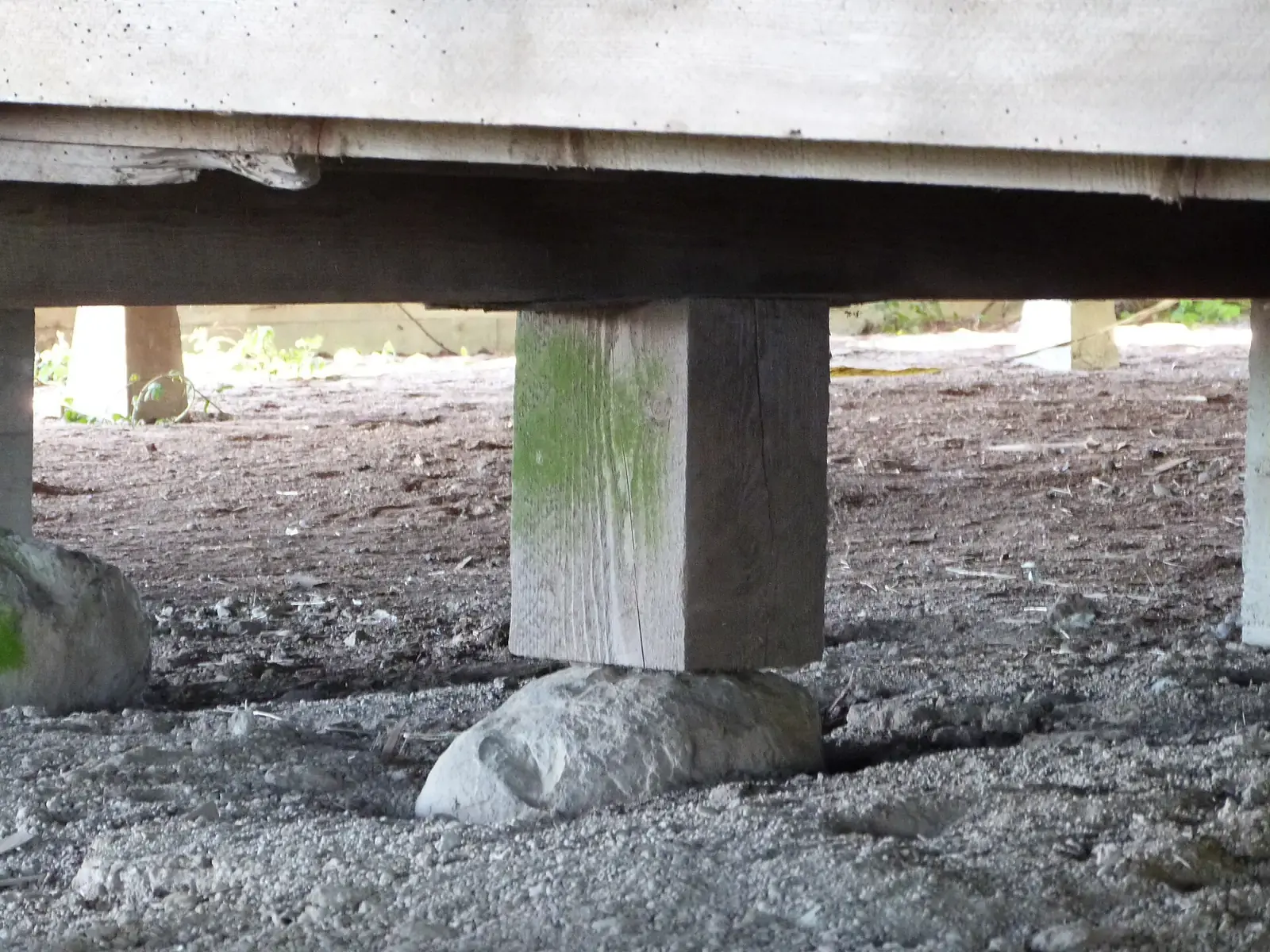
| Floor that bounces or slopes toward one wall | Damp or rotted joists, or a failed pier | Look under the floor with a flashlight |
| Pier that leans or has slid off its footing | Soil movement on a slope | Photograph it from two sides with a plumb line |
| Retaining wall that bulges | Water pressure behind it | See whether drains are clear, then call an engineer |
When it is the slope, not the house
A foundation repair company works on the structure. If the ground itself is creeping, new piers will not fix it. Signs are fresh cracks in the yard or driveway, trees that lean downhill, and fences that open at the joints. In that case ask a licensed North Carolina professional engineer who works in geotechnical problems. The City of Asheville approved more than $9.5 million for landslide repair work, according to Fox Carolina on 30 June 2026, which shows how large the problem became after the storm.
How repairs commonly work
This is background, not a recommendation. For a settled pier or footing, contractors often add a new support under the old one, such as a steel push pier or a helical pier driven to firmer ground, or they rebuild the footing. For a bowed block wall, steel or carbon fiber reinforcement is common. For a wall with water against it, drainage outside is usually part of the answer. The cause decides the method.
Questions to ask any visitor
- What is moving, and how do you know it is still moving?
- Will water be redirected, or only the structure fixed?
- Who applies for the permit, and with which office?
- Is the method named in writing?
- What state licence applies to this job, and what is its number? North Carolina requires a general contractor licence on jobs of $40,000 or more, so ask even on smaller jobs (N.C. Gen. Stat. 87-1; check nclbgc.org).
Most local companies offer free estimates, so collect more than one. Prices are on the price page, and the permit page lists the county office.
Where these facts came from (read 4 November 2026)
- USGS landslide inventory for Hurricane Helene, counts as reported in news coverage and USGS releases.
- Fox Carolina report on Asheville landslide repair funding, 30 June 2026.
- N.C. Gen. Stat. 87-1 as summarised by the NC Licensing Board for General Contractors; confirm the current text with the Board.